
How many students in a choir of 35 need to be able to sight-sing for the teacher to hear the class sight-singing?
Often only 1.
The resourcefulness of singers to split-second imitate music reading has been our lifeblood since the beginning of choral music. This skill is unique to choirs. Instrumentalists can’t do it. Every player in band or orchestra must be able to read their score to participate. But for many vocal ensembles, from elementary to adult, the repertoire-learning process is often imitation of the pitches and rhythms they hear and rote memorization.
While this ability helps prepare for the performance, it also masks a somber reality—or dare I say a disability? That is, the lack of music literacy and the capacity to read music. We would all decry a school where students don’t learn to read their language. Indeed, it feels like society has failed any adult who cannot understand the written word. Language literacy opens the world to readers and helps them navigate everyday life.
Why, then, are we okay leaving singers in the dark, dependent on someone to play their part on the piano or sing their part within earshot? Research on sight-singing pedagogy reveals some startling facts. Did you know that instrumental participation is a stronger predictor of sight-singing achievement than vocal ensemble participation? In other words, a student who has played in the band for three years will typically be a better sight-singer than a student who has sung in the choir for three years. Why? Music literacy is often not taught in choir, and singers can survive by rote learning.
I come to my point. Choir Directors: find a way to teach music reading in your choral rehearsal. Research has shown that sight-singing lessons, as short as two minutes, have resulted in a significant difference in the ability to read music. Yes, two minutes can move the needle when sight-singing instruction happens in every rehearsal. Over time, singers will rely less on rote learning and more on reading. Rehearsal pace will increase because the singers learn their parts faster. More time will be available to focus on musicality and expression. It’s a WIN-WIN for everyone.
Here are some practical tips for choral educators:
- Choose a system and teach it consistently. No approach to sight-singing pedagogy has emerged from the research as “most effective.” Not Kodály or interval-based, not numbers, not moveable do or fixed do, nor any particular rhythmic mnemonic strategy. Results point to teacher commitment and consistency as the major drivers of student achievement. Pick a method you are comfortable with and teach it enthusiastically.
- Hold learners accountable. Research indicates that individual assessment appears to promote individual musicianship. In other words, keeping students accountable provides motivation. When singers realize they cannot lean on those around them, their effort and engagement increase. They make greater improvement in their own music literacy skills, which then boosts the musicianship of the whole choir.
- Keep the routine short and predictable. Place sight-singing early in each rehearsal. Teach, model, practice, review, give feedback, and repeat. Track progress week by week so students can see their growth.
- A note for church choir directors. I highly recommend you offer sight-singing lessons to the volunteers in your choir as well. By the time singers reach adulthood, they realize how limited they are because they cannot read music. They are highly motivated to learn if given the opportunity. Furthermore, these singers can strengthen your choir for years as they faithfully serve in your music program.
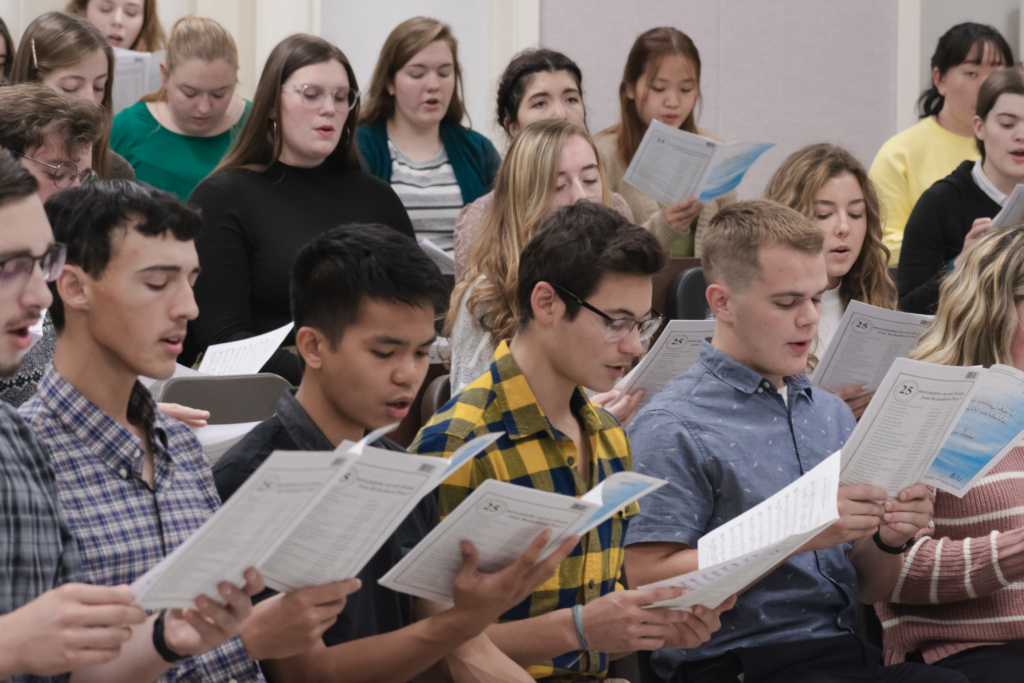
I direct a choir of 75-100 freshmen university students. Each year, I have a brand-new choir. Many have never sung in a choir, and most do not know how to read music. In almost every rehearsal, we spend 2 to 5 minutes on a sight-singing lesson. One of my career passions is helping singers unlock the mysteries of those little black dots on a score so they can become independent musicians. I can’t tell you how many times students have told me they feel more confident, that their eyes are now open to a new world of music, and that they have found a new love for choral singing. These comments reinforce my commitment to teach sight-singing. My choral mission is not just to get the music ready for the concert, but to prepare my students to serve in church music ministry for the next 50 years. I teach sight-singing because…
If I play the notes for the choir, I feed them for a day.
If I teach them to read music, I feed them for a lifetime.