
How did you learn your first language? Most people learn it through sound and imitation. From day one, adults speak and you listen. Over time, you begin to babble as you copy the sounds you hear. Soon, you form simple words, then short phrases. Only after several years do you learn the ABCs and the sounds they represent. Once you know the symbols, you combine letters into words and words into sentences.
Now, picture this. You’re in the 4th grade and you want to learn to play the trumpet you found in your grandfather’s attic. You pull out the method book from the case. Lesson one shows a note and explains, “This is a whole note, and it gets 4 counts.” Next comes a half note for 2 counts. The next note looks different from the others because it’s colored in. The caption says, “This is a quarter note, and it gets 1 count.” At the bottom of the page, you see a five-line staff labeled “Treble Staff” with noteheads on different lines and spaces. Bravely, you push a valve, blow into the mouthpiece, and attempt to play what you see. It does not sound like music. It sounds like a random car horn.
These two scenarios use opposite starting points. The first starts with experience. The second starts with symbols. That contrast matters. Johann Heinrich Pestalozzi, a Swiss educator born in Zurich in 1746, developed a new approach to teaching. He argued for educating the whole child through head, heart, and hands. He stressed love and learning that moves from concrete experience to abstract ideas. His work influenced schooling far beyond Switzerland.
Music Education is a prime example.
Four Pestalozzian Principles have great value for us and help us provide a child-friendly foundation for teaching music.
- Teach sound before symbol. Students grasp music more naturally when instruction is “sound before symbol” or “experience before explanation.” Children sing words with a dotted 8th and 16th note rhythm in simple folk songs before they learn the notation that matches the sound. Recorder players echo pitch patterns that the teacher plays and later read them from a score. The younger the students, the more sound experiences they need before reading the symbols of music.
In the elementary music classroom, we don’t study form by first learning the terminology music theorists use. No, we learn to identify form by listening and moving. When the section changes from A to B or from theme to variation, we change the movement expressed through a scarf, streamer, or other manipulative. After repeated listenings, students can easily attach labels such as ABA, rondo, or theme and variation to what they have already heard and felt.
- Learning should be active rather than passive. Our biblical worldview supports this idea. James 1:22 says, “Be doers of the word, and not hearers only.” Music learning thrives on doing. Students don’t learn to sing or play by reading a book or listening to a lecture. Rather, master ensemble directors, for example, will speak just a few words when they stop to fix or nuance the music. They correct or refine, then immediately run it again. Active rehearsal builds skill faster than long explanations.
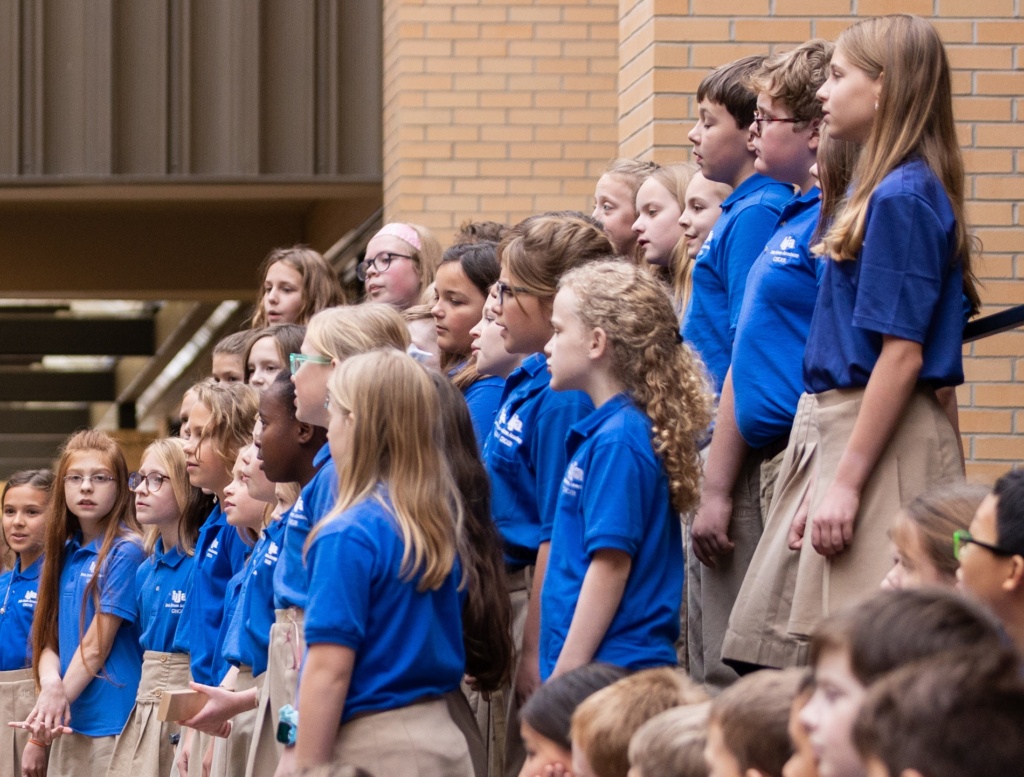
A Kodály-inspired music lesson is active almost from start to finish. Students sing a greeting song. They chant a rhyme with movement. The primary focus might include singing, clapping, writing, or reading to decode a rhythm pattern that they sang the previous week. The change of pace is often a game like matching pitch names to a large floor staff or keeping the steady beat with the classic orchestral work, “In the Hall of the Mountain King” by Edvard Grieg. Zoltan Kodály was an ardent supporter of active, play-like lessons for children.
- Teach one concept at a time – break complex concepts down into simpler bits. Good teacher-designed scaffolding focuses on a concept and breaks its elaborate skills into smaller steps. We teach the elements of music across many years. Rhythm, melody, harmony, timbre, texture, dynamics, and form appear again and again at increasing levels of difficulty. Isaiah recommends teaching Scripture the same way. “For it is precept upon precept… line upon line… here a little, there a little” (Isaiah 28:10). Learning builds through small, ordered steps.
Early grades show this progression. Kindergarten students hear long and short sounds. First-grade music introduces ta and ta-ti with stick notation. Second grade adds half notes and expands with rhythmic dictation. Each year builds on the last. The goal is independent musicianship by graduation from high school.
- Practice and master before moving on. Music educators facilitate this principle through intentional short and long-term planning. Musicians need repeated practice to internalize their skills. Private lessons reinforce the same truth. Frequent review builds retention. Thoughtful repetition builds confidence and mastery.
So now you know the secret sauce of music teachers. We utilize the 200-year-old wisdom of Johann Pestalozzi and begin with the sounds of music and keep learning active and sequential. With this approach, improvement is steady from pre-school and beyond.