
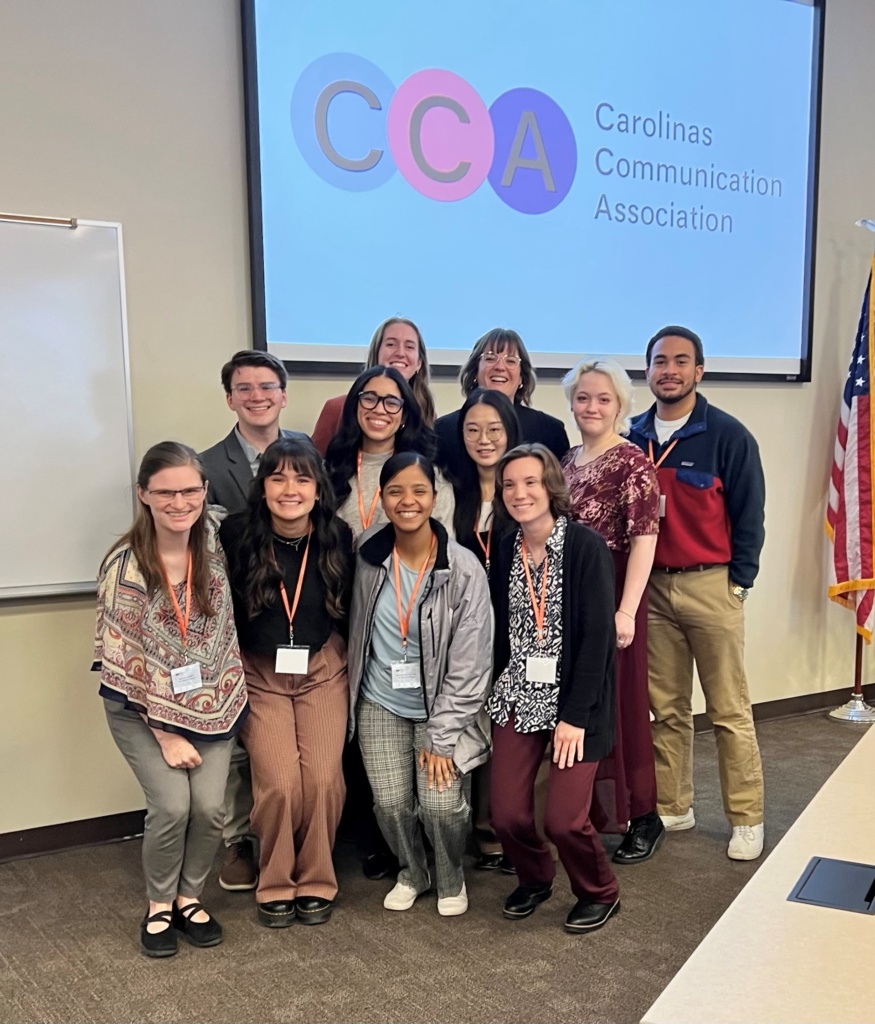
Several graduate students in Bob Jones University’s Department of Communication Studies presented their research papers at the Carolinas Communication Association conference at Campbell University, Raleigh, NC, on Oct. 10-11, 2025.
Carolinas Communication Association (CCA) promotes communication studies in the Carolinas and across the region by hosting conferences, publishing a journal, and providing resources for instructors and students. Undergraduate students, graduate students, and faculty can submit papers covering all methods and aspects of communication studies, as well as their interests, for presentation at the regional CCA Annual Conference.
Four BJU graduate students presented their research papers: Adam Banks, Hannah Bray, Ruth Urraca Mata and Daniela Paul. Hannah Bray presented two academic papers titled “Spotify and Structure: Exploring Spotify’s Work from Home Policy Post-Covid through Structuration Theory” and “To Disclose or Not to Disclose: A Qualitative Study of College Students’ Online Disclosures.”
“This has been an amazing program. It’s taught me a lot about people, collaboration, and how to communicate in different contexts,” said Bray. “I appreciate the time teachers have invested in us and for the work they do to make our experience applicable to real life, even when we study more abstract concepts, like theories.”
Ruth Urraca Mata presented her research on “Fostering Family Involvement in the School Community: Immigrant Parents’ Perspectives on Sense of Connection.” Adam Banks’ presentation of his paper, “Leading Generation Z: How Generation Z May Be Motivated to Work”, was a memorable moment for him.
“After spending so much time and effort in the research phase of my project, it feels gratifying to present the research where it may be used to further current research in this field,” said Banks. “Being in this program and seeing hard work pay off in this professional setting is very rewarding. It was a great experience getting to present my research!”
Daniela Paul won the 2025 Mary E. Jarrard Award for her paper titled, “Where Do I Belong? Family Identity in Interracial Adoptive Families.”
“Being a communication graduate student here at BJU has opened up doors to learn new skills that I didn’t know I would enjoy as much as I do,” said Paul. “Writing the paper and conducting the research was definitely difficult at times; it took a lot of time and work, but it was one of the most rewarding things I’ve done in graduate school. To be able to choose a topic that is so important to me, and one that will hopefully help me in my future career, was amazing.”
The Mary E. Jarrard Award is given to the author of the top graduate paper. This is the sixth time that a BJU student has received this honor since BJU joined the CCA in 2014.
“I’m so grateful and humbled that I won the prize for best graduate paper of the conference,” said Paul. “It was daunting to present for the first time, especially when most of the listeners were communication professors or PhD students. But I knew that my classes had prepared me for this. I’m grateful for the University’s high standards that help us distinguish ourselves among our peers.”
In addition, Dr. Beth Ann Labadorf, communications faculty, showcased a Great Ideas for Teaching Students (GIFTS) presentation called, “Why Do We Need Support Llamas? An Application Activity for Monroe’s Motivated Sequence Persuasive Organization Pattern.” She also presented a research paper titled “A Timeline of Crises: A SCCT Crisis Response Analysis of Facebook’s Major Crisis History.” Her research paper received the Ray Camp Award which is given to the Top Faculty Research Paper. Labadorf is the first BJU faculty member to win this award.
“I am humbled to receive the Ray Camp award, and I praise God for this opportunity to show the quality and diversity of our faculty qualifications at this liberal arts institution,” said Labadorf. “I am immensely proud of our graduate students for presenting their research at this conference. It is an amazing opportunity to highlight the quality of our program and the deeper insights they are gaining through research into everyday human interactions.”
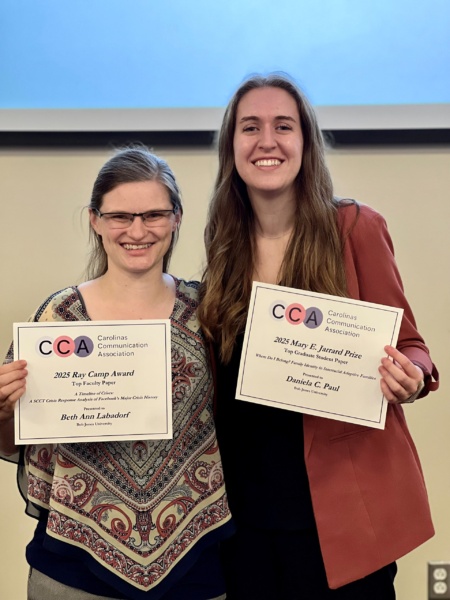
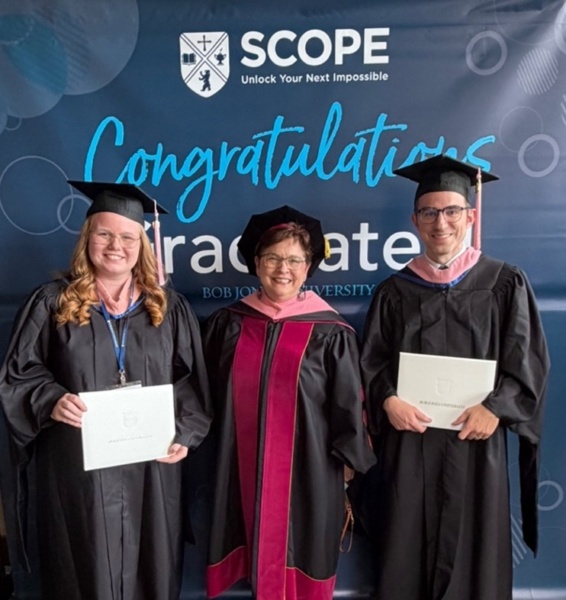
Dr. Labadorf (left) and Daniela Paul (right)